
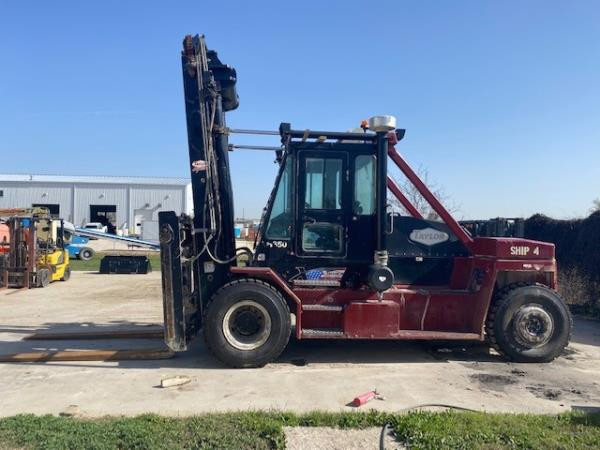

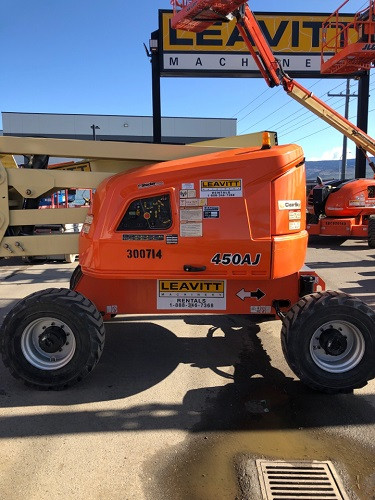


Telehandlers are heavy duty work machines made specifically to operate in rough environment. This however, does not mean they could be driven without consideration on rough terrain. These types of machinery have a a lot bigger risk of tipping over or load loss when they are traveling on slopes.
If you do have to travel on a slope, make sure that you proceed slowly and carefully while keeping the load low. Prior to getting on the slope, downshift to 4WD and a lower gear. Utilizing the engine brake would help to control the telehandler's speed. Try not to turn on a slope if possible. If you must make the turn, utilize extreme care and take it as wide as possible.
Always try to avoid driving across extremely steep slopes. Use the telehandler's heavy end pointing up the incline, when descending and ascending slopes. Even when there is no load on the forks, the counterweighted rear of the machine is fairly heavy; thus, it can be necessary to drive backwards up slopes. When the telehandler is carrying a cargo, the front of the unit becomes the heavy end, and you can back the machinery down the slopes.
On a mixed jobsite, operator training is really essential. The coordinated steering machines, along with the rear-pivot machines usually work on the same jobsite where everybody is permitted to use all of the equipment. In this case, a person who is used to using a coordinated steer machinery can jump onto a rear-pivot machine. A really key difference between how these two units work depends on what part of the machine extends outside of the turning radius.