







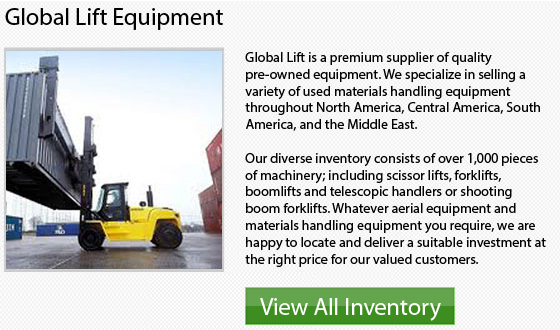
Since its introduction in the early 1920s, the forklift has become an important piece of machine found in many warehousing and industrial operations. Clark, among the pioneers of the first lift truck, has grown to become a leader within the material handling industry and still remains a leading supplier. Various other well-known names in the making of these machines include: Nissan, Yale, Hyster Cat, Toyota and Mitsubishi.
The Hyster type of forklift has become amongst the industries most popular manufacturers. As a matter of fact, in several regions, the word "Hyster" is synonymous with forklift. Other common names for this industrial lifting equipment consist of: stacker truck, fork truck, jitney, high/low and lift truck.
It was during the 19th century that the machinery ancestors of the forklift was first made. At this time, battery-powered, small models were made for the purpose of moving traveler's luggage at the Altoona train station within Pennsylvania. During the First World War, various kinds were developed within England specially to be utilized in the material handling business. These machines evolved as a solution to the manpower shortage at that time.
The modern equivalents come in a variety of sizes and configurations. There are the large truck-mounted lift truck units that are also referred to as sod loaders and then the opposite end of the spectrum has small hand truck models. There are also a line of automated versions known as forklift automated guided vehicles which are practically robotic in nature. These units were developed as a way of lowering operational expenses and to improve production.
Attachments have been made to fit onto a lot of common forklifts, giving them the capability of performing a wider selection of tasks. The motors could be IC or internal combustion models, working on propane, diesel or gasoline, or there are battery operated options which require regular charging. Typical warehouse models will usually be rated to lift between around 1 and 5 tons.
The forklift has become a priceless component within the material handling industry. Many of these units are utilized each and every day all over the world to perform tasks which used to need much more man-power. Operators must take stringent training programs in order to run these heavy machines legally and safely. Numerous employees have longer careers now and better overall health due to their not having to raise objects by hand anymore because the forklifts could handle those situations now instead.